Artists
A Pair Fit For Paris
The Collaboration Between Salvador Dalí and Pierre Argillet
What would it have been like to be a teenager in 1920s Paris? To have seen the freedom and possibility of a post-World War I France. Paris was a haven for creative Europeans and Americans alike; what would the atmosphere have been like? To sense the energy, the mystique, almost like a scene from Woody Allen's Midnight in Paris. The young Pierre Argillet was fortunate enough to be an onlooker to this artistic microcosm.
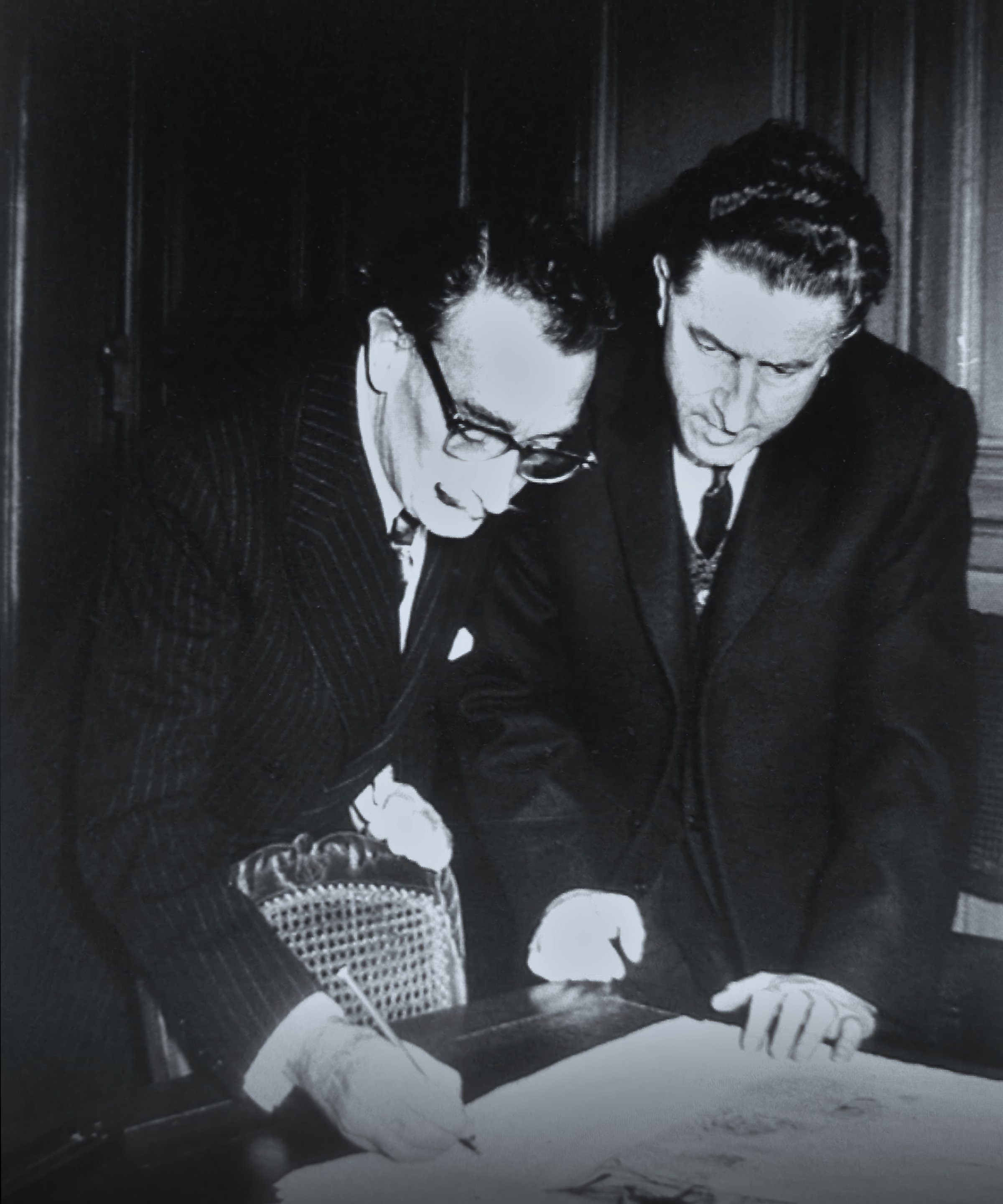
In 1930, the twenty-year-old Pierre Argillet was already an avid collector of the Futurists, Dadaists, and Surrealists' works. Very early on, he met the most significant artists of the 20th century. As a freelance journalist — he was never without his trusty Rolleiflex camera — Argillet stumbled into a community that would make generations of romantics extremely envious. He counted Duchamp, Di Chirico, and Jean Arp among his acquaintances, but when he met the incomparable Dalí, it led to a life-long friendship that lasted until the painter's death in 1989.
In 1959, Argillet and his wife and partner Geneviève Argillet met with the preeminent Salvador Dalí to commission a copper engraving for their first illustrated art book. This meeting led to a thirty-year collaboration, but more importantly, a life-long friendship. The personal relationship between Dalí and Argillet strengthened the beauty, depth, and longevity of this collaboration. It was more than just the relationship of an artist and his publisher — it was a creative and nurturing exchange that would lead Dalí to create his finished etchings.

When Argillet and Dalí initially met, they had discussed what subject matter Dalí might etch. Pierre had suggested the ancient world and its mythology, and the subject immediately intrigued Dalí, who was always interested in concepts larger than conventional comprehension. Argillet realized that he would need to work side-by-side with Dalí, without the distractions of Paris, to allow this collaboration to succeed.
To work more closely with Dalí, Pierre and Geneviève took their children every summer for fifteen years to the rugged Costa Brava of Spain, where Dalí spent his summers in Port Lligat, just forty-five minutes from his hometown of Figueres. Less the famed "DALI" and more the comfortable Salvador, this atmosphere allowed for a broad body of work and a trusting relationship between artist and publisher. Dalí would etch all summer, and throughout the following year, he and Argillet would return to Paris to work with the most reputable printmakers.
The marvelous Salvador Dalí – Pierre Argillet Collection, created during all of the beautiful summers, comprised several thematic suites. The suites cover topics of great interest to Dalí — timeless pieces of literature and issues of great depth and mystery. As would be expected, Dalí was drawn to great accomplishments in literature. Their subject matter was rich enough for Dalí to interpret in his own unique way, whether it was ancient mythology, the story of Doctor Faust, or the surrealist mantra of Isadore Ducasse's Le Chants de Maldoror. Dalí was more than willing to explore the visual interpretations of some of the most recognizable and complicated literary works.
What makes this collection so special is not just the subject matter chosen for this collaboration or the close personal relationships that gave rise to it, but also Dalí's sheer skill as an artist. Dalí worked primarily with a diamond stylus, etching directly into the unforgiving soft copper plate. Much like a drawing, but pressing into the metal with incredible precision and delicacy to produce images that would appear in reverse when pressed. The bold lines, as well as the softest cross-hatching, give each image amazing detail and depth.

Pierre and Geneviève Argillet spent years of their lives as admirers of Salvador Dalí. They were friends, colleagues, and publishers for this visionary artist and fortunate to have brought their children along for the ride. The Dalí/Argillet collaboration ended in 1973 when the artist chose to publish work through offset lithography. Argillet felt lithography was inadequate to communicate Dalí's brilliance, though the two remained fast friends until the artist's passing in 1989. Argillet continued to promote the collection until his own passing in 2001, at which point it passed to his son Jean Christophe, who has maintained the integrity of the collection since and is actively involved in a nascent renaissance of Dalí's artwork. In 2005, Jean Christophe Argillet wrote The Century of Dalí, preserving his childhood experience with the artist and passing on the family stories that are the younger Argillet's legacy.
Jean Christophe Argillet continues to promote and educate on the amazing collection that his parents created. In an attempt to preserve these personal stories and insights into these works, Triad Art Group, in collaboration with Jean Christophe Argillet, has created the first complete catalogue raisonné of the Salvador Dalí – Pierre Argillet Collection. The collection includes beautiful dry-point etchings, unique one-of-a-kind studies, as well as stunning Aubusson tapestries of selected images from the collection.

In 1971, Pierre Argillet founded the Museum of Surrealism at the Château de Vaux-le-Pénil in Melun, France. This collection, along with the works of many other surrealist artists with whom Argillet had collaborated, adorned the walls of this 73-room château overlooking the Seine. Most striking was the presence of the impressive Aubusson tapestries dramatically hung over the walls.
Along with Argillet's Museum of Surrealism, the Argillet-Dalí collection has also appeared in some of the best-known museums in the world: Dalí Theatro-Museo, Figueres, Spain; Musée Pushkin, Moscow; Musée Boymans, Rotterdam; Kunsthaus, Zurich; Staatsgalerie, Stuttgart; Isetan Museum of Art in Tokyo; Daimaru Art Museum, Osaka; and the Hiroshima Prefectural Museum of Art, Japan; and the Reynolds-Morse Foundation, St. Petersburg, FL, now the Salvador Dalí Museum.


