
It is widely agreed upon that French artist Pierre-Auguste Renoir was a leading painter in the 19th century Impressionist art movement — an art form that encompasses a different way of seeing and acts as a form of immediacy and movement. Capturing the fleeting qualities of light, color, and atmosphere, as well as the emerging psychological principles concerning human consciousness, it was a new and controversial practice. Radical artists of the time violated the rules of academic painting, often being the target of scrutiny for it.
These bold artists are masters of their craft, but it is notable that it was not men alone who rebelled against what was acceptable. Due to the socio-economical and political inequalities between the sexes, women were often excluded from the bourgeois social sphere of the boulevard, the café, and the dance hall — the very spaces where male Impressionists formed and shared ideas. This did not keep ladies away from the art form. Mary Cassatt, Berthe Morisot and Marie Bracquemond painted their influential way into art history, becoming the three ladies of Impressionism — les trois grandes dames.

A Life Against the Odds
Bracquemond is unjustly much lesser known compared to Cassatt and Morisot, who both had supportive influences from the early days of their painting careers. Her personal story is filled with struggle from early childhood. Losing her sea captain father at a fragile age threw her family into rough waters, and her re-married mother often navigated life with frequent uprooting. Spending much time moving and resettling as a working-class family did not leave Marie freedom to establish roots.
Marie's first painting attempts started with a birthday present to her mother, having made her own pigments out of crushed flowers. Whilst living in Étampes, Marie insisted on painting lessons and ended up under the tutelage of M. Wasser, an art restorer. She never received the formal training available to women from higher societal classes. Regardless of not being born into wealth, her path crossed with neoclassical artist Jean Auguste Dominique Ingres, who saw her talent and guided her developing style. He encouraged Marie to submit to the Salon as one of his students in 1857. Not only did she follow the suggestion — her work was accepted on the first try, at the young age of 16.
"She marks a significant chapter with a shift in art history at large, making her one of the Women of Impressionism.
— Marie Bracquemond
Soon she was receiving commissions of her own, creating original works, and also commissioned to make copies of masterpieces at the Louvre. It was there she met her future husband Felix in 1867. Marie's talent was already apparent, albeit still fully developing the unique style that would later be strongly influenced by Degas, Gauguin and Monet.

An Oppressive Marriage
Once married, Felix — who was a painter and etcher — introduced his new wife to the art of etching. They often worked together creating etchings for plates, panels, and the Society of Painter-Etchers. The marriage seemed a perfect pairing of artists bonding over their love of creating. According to their only son Pierre, however, it was Felix who ended up holding Marie back, as their personalities and artistic styles proved incompatible.
At the turn of the 1880s, Bracquemond shifted towards Impressionism. Moving from her studio to en plein air (the outdoors), she initiated the effort to capture the delicate play of light, painting white dresses and often cropping her work to capture delicate moments. Her forms were less sketchy or spontaneous, and more planned than many fellow artists. Marie was a planner — she worked diligently, borrowing from her Neoclassical training and finished surfaces customary to the classical style.
To her husband's dismay, Marie began exhibiting with the Impressionists in 1879, 1880 and 1886. Since most of her work went to private collectors, lacking any substantial public exhibitions, her legacy in artwork is stunted. Felix did not see eye to eye with Marie's vision and adversely kept her art from the wider audience by refusing to show it to guests. It was largely kept hidden from public view.

The Legacy She Deserved
A family friend and art critic, Gustave Geffroy, described Felix as authoritarian and argumentative. Their son Pierre — the biggest supporter of his mother's work — describes his father as someone who sought isolation for his family. Despite Marie's gift, drive, and enthusiasm, her ailing health, oppressive marriage, and familial obligations eventually caused a stoppage to her painting.
It is only recently that art historians have researched and observed artists with more diverse backgrounds. Art historical narratives have been highly stringent to change. This factor, as well as a lack of support with the opportunity to exhibit and widely produce work, has kept Marie Bracquemond's legacy unjustly small.
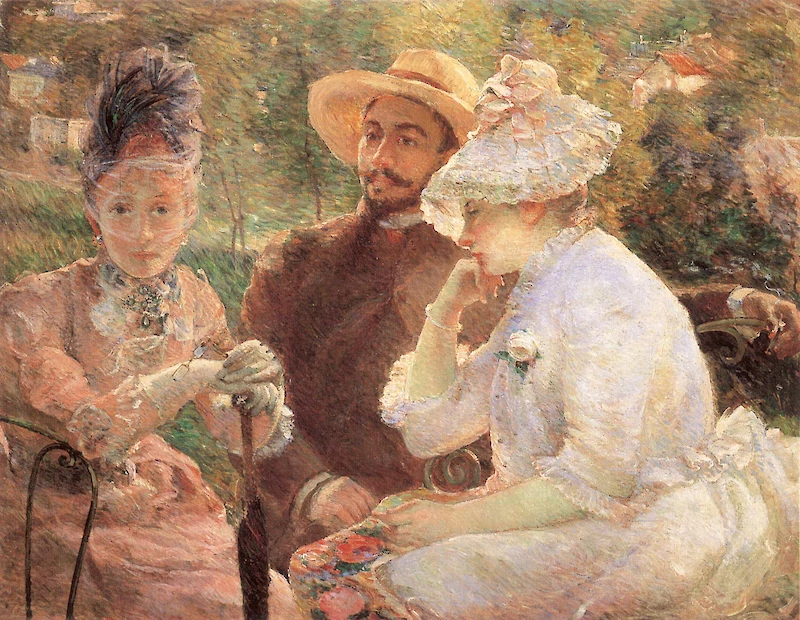


Trois Femmes · Marie Bracquemond · c. 1880

Pierre and His Aunt Louise in the Garden · Marie Bracquemond, 1886
Yet she marks a significant chapter with a shift in art history at large, making her one of the Women of Impressionism. An artist who has rightfully earned the grande title next to Cassatt and Morisot.