
Culture
The Grande Dames of Asian Cinema
The Trailblazing Women Who Opened Hollywood's Doors
What does it mean to be a Grande Dame? At times it is given a wide berth, used to describe persons, places, or physical objects that have stood the test of time and become symbolic of a larger concept. Traditionally, one uses the term to pay homage to women of high ranking or expertise in a particular discipline, profession, or craft. When developing the thesis of this story, the term revealed itself as the most succinct and apt description for the trailblazing women of Asian cinema on our cover. These doyennes of film not only carved a place for themselves in the annals of the entertainment business, but also pioneered the way for many Asian actors throughout Hollywood.
Widely regarded as the first Asian trailblazer was actress Anna May Wong — a third-generation American known to be the first female Asian-American movie star from the silent film era. This was during a deeply racist time, with anti-miscegenation laws preventing a nonwhite woman from being cast opposite a white man in America. Frustrated with the discrimination and limitations, Anna May Wong went to Europe for work in English and German films. With much perseverance, she caught a break in the United States with The Toll of the Sea in 1922, opening the door for 30 film credits in the 1920s and another 29 from the 1930s to 1961. Her career set the wheels in motion for the storied careers of Lisa Lu, Kieu Chinh, France Nuyen, Nancy Kwan, and Irene Tsu.

Lisa Lu
"I actually wanted to be an Opera singer — especially as my mother was an accomplished one," recalls Lisa Lu. "But when my mother told me I didn't have what it would take to become a good Opera singer, she encouraged me to be a banker since I was good at mathematics and a trustworthy person. Then shortly after we moved to Los Angeles in 1957 for me to study, I expressed my desire to be an actress at 30 years old. My parents encouraged me to study acting so I enrolled at the Pasadena Playhouse, where I graduated in a year and a half." Soon after, Lisa booked her first television appearance in The Gale Storm Show: Oh! Susanna (1958). "There were many good Asian actors and actresses at that time but not enough parts because we lacked Asian writers who knew Asian stories," she observed.
Her first notable film role was in The Mountain Road (1960), a film considered taboo for Hollywood as it touched on tensions between allies during the war years and racism among Americans. "Since I came from China and the war, my acting was very vivid and true. So, they chose me to be the lead," Lisa remembers.

The Empress Dowager (1975), produced by the renowned Shaw Brothers in Hong Kong, holds a special place as one of her favorite roles. "This film gave me an opportunity to play a very dynamic character. And I really enjoyed working under Director Li. He's marvelous," Lisa says. She went on to star in the landmark film The Last Emperor (1987) — the first Hollywood film made in and about China with full Chinese government cooperation since 1949, and the first Western feature authorized to film in the Forbidden City of Beijing.
"Initially, the writer Bertolucci approached me with a role, but he ended up needing to scrap the character. When I saw him six months later and asked why they hadn't started filming yet, he said he was still looking for an old woman to play an elderly Empress Dowager. I told him he wasn't looking for an old lady — he was looking for a good actress. The next morning after a test shoot, they got the makeup team, and we began filming." When asked how old she was versus the character she played, she laughed: "I was 60 at the time playing someone in her 80s. But even when I was 65, I played a role of a 17-year-old. I guess you can say I look good for my age." That film went on to win 9 Oscars.


France Nuyen
20th Century Fox called her the next Anna May Wong. In 1957, France Nuyen stepped onto the scene — a Eurasian raised in Marseilles, it was in New York that Candy Jones Canover arranged an interview with Joshua Logan, Oscar Hammerstein, and Richard Rodgers. The result was a seven-year contract with 20th Century Fox. Her first role was as a lead in the American romantic musical South Pacific (1957) — before she could even speak English. As the film was based on a Pulitzer Prize-winning book and the 1949 musical, it was an exceptional start.

"I am grateful for what this world has given me coming from my humble background. My brave mother raised me by herself in Marseilles, my hometown, occupied by the Nazis during the second World War. She survived to keep me alive. It is her courage that made possible for me to be who I am today," France elucidates. In 1958, France went on to star in the original Broadway stage production of The World of Suzie Wong, for which she received the Daniel Bloom Award. At just 19 years of age, she landed the cover of Life Magazine.


Today France is most known for her role as the "Dohlman of Elas" in the third season of the original Star Trek series (1968), which continues to connect her with younger generations. Her personal favorite TV role is the series St. Elsewhere (1986–1988), in which she played Paulette Kiem, a Chief of Surgery fighting for her position. "They took in what we had to offer, treating us as equal creators," France explains. "You walk onto their set and you felt you belonged." At the height of her career, France pursued further education, earning a Master's Degree in Psychology and working with abused children, women in prison, troubled youth, and people suffering from addiction — work that resulted in her being awarded Woman of the Year by the City of Los Angeles in 1989.

Nancy Kwan
"I started off wanting to be a ballet dancer and somehow fate had other plans!" Nancy Kwan exclaims. Nancy got her big break in 1959 while studying dance at the Royal Ballet in England. She was home in Hong Kong for summer holiday and decided to attend an audition. "Producer Ray Stark approached me and, seeing potential, he had me do a screen test of my own. The next thing I knew, I was signed to Ray Stark for the next seven years," Nancy recalled. "I hung up my toe shoes to become an actress."
"Shortly after going to Hollywood, I joined The World of Suzie Wong national touring company. Seven weeks into it, I received a call from Ray Stark. He told me I was to go to London the next day as the new lead of the film opposite William Holden. It was a dream come true!" Based off a best-selling novel, the historical film captured the world's attention at a time when sex, prostitution, and interracial relationships were taboo subjects. Nancy was awarded the Golden Globe for Most Promising Newcomer–Female that year.

Nancy became one of Hollywood's most visible Asian actresses with the hit musical Flower Drum Song (1961) — the first Hollywood movie musical with Asian Americans as leads. "I was looking forward to working with Anna May Wong in this film, but unfortunately, she passed away just before we started shooting. But I still had a wonderful time — it was great being able to combine my love for dance with my new acting passion."


Kieu Chinh
Having started her acting career in 1957, Kieu Chinh first appeared on American screens landing a role opposite Burt Reynolds in Operation C.I.A. (1965). Her rising career was dealt a blow with the fall of Saigon on April 30, 1975. Kieu's attempt to return home to Vietnam was met with arrest — her miraculous journey led to becoming the first Vietnamese refugee in Canada, and with help from Tippi Hedren, she managed to escape her circumstances and rebuild her career in America.


Kieu caught a landmark break with the role she is most known for — Suyuan in The Joy Luck Club (1993), based on The New York Times bestseller. France and Lisa both appear in that film as well. A historical production for having a mostly Asian cast and crew, the world would wait another 25 years before seeing this again with Crazy Rich Asians in 2018. In 1993, Kieu founded the Vietnam Children's Fund alongside journalist Terry Anderson and author Lewis Puller Jr., which has since built 51 schools across Vietnam and provides safe education for more than 30,000 children annually. She will be the first to receive a Humanitarian Award from the Asian World Film Festival.
Irene Tsu
Starting as an uncredited chorus girl in Flower Drum Song, Irene Tsu went on to enjoy a five-decade career. Henry Kosta, the director, was a huge catalyst — he gave Irene an important part in Take Her, She's Mine (1963) starring Jimmy Stewart, which earned her a SAG card. She famously worked alongside Doris Day in Caprice (1967) and Elvis Presley in Paradise, Hawaiian Style (1966).

"Working with Elvis was unlike any other," she swooned. "I met him accidentally because the AC was not working in my trailer. I walked into a nearby building to cool off and little did I know it was Elvis's dressing room. When I opened my eyes, I saw Elvis's face 12 inches from mine applying a cold compress on my forehead. The fragrance of milk and Johnson's Baby Powder drifted by — I took a deep inhale and burned the scent and his beautiful face into my psyche forever." Of Elvis, she shared: "He was a very sweet southern gentleman. We spoke about martial arts and faith. Filming a scene with him was unique as the King never rehearsed."

Irene became the female lead in The Green Berets (1968) starring John Wayne. "I learned a lot about the reality of war from that film having spent nearly four months at Fort Benning in Georgia. What you saw was the real stuff — special forces and the U.S. military at work." Irene made headlines with her memoir, A Water Color Dream: The Many Lives of Irene Tsu, in which she shared her relationship with Frank Sinatra in 1969 through 1971. "One date that lasted more than two and a half years. We remained friends, and he even gave me a wedding present!"

Irene is still working today. She completed Away in 2019, lent her voice to the Oscar and Golden Globe-nominated Netflix animation Over the Moon (2020), and this year the documentary Atrophy won her a Best Actress Award on the festival circuit.
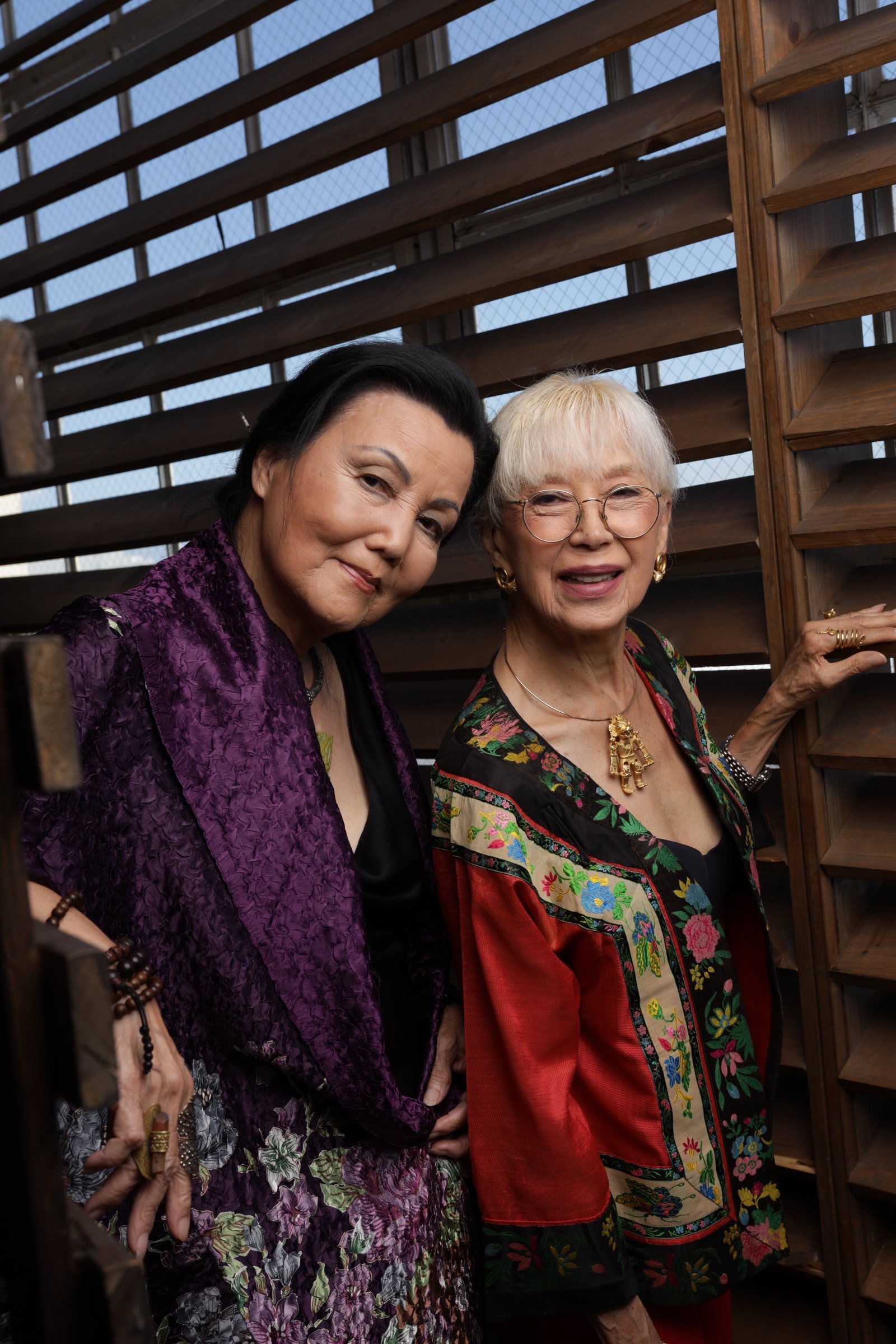
Photography: Fabian Lopez.

Photography: Fabian Lopez.
When asked about the role they have played as pioneers in Hollywood, the general consensus is that they helped the industry gain confidence in hiring Asian actors. With a reputation of being on time and prepared, it became clear they were serious about their profession. And while all of these women have certainly paved the way for countless Asians and Asian Americans, they are all deeply grateful for the support they have received throughout their journey.

— Nancy KwanIt is almost impossible to sustain a career in films without getting good roles — which there weren't a lot of for Asians at the time. I was fortunate, and I am extremely grateful for the opportunity to follow my dreams.